AUTO REPAIR SEO
Show up for the repair services you want to sell.
We make your service pages easier for drivers to find, understand and act on. Start with the repairs that make sense for your shop.
GO FILL THE BAYS by OTG
WHERE IT BREAKS
Traffic can grow while the wrong customers keep showing up.
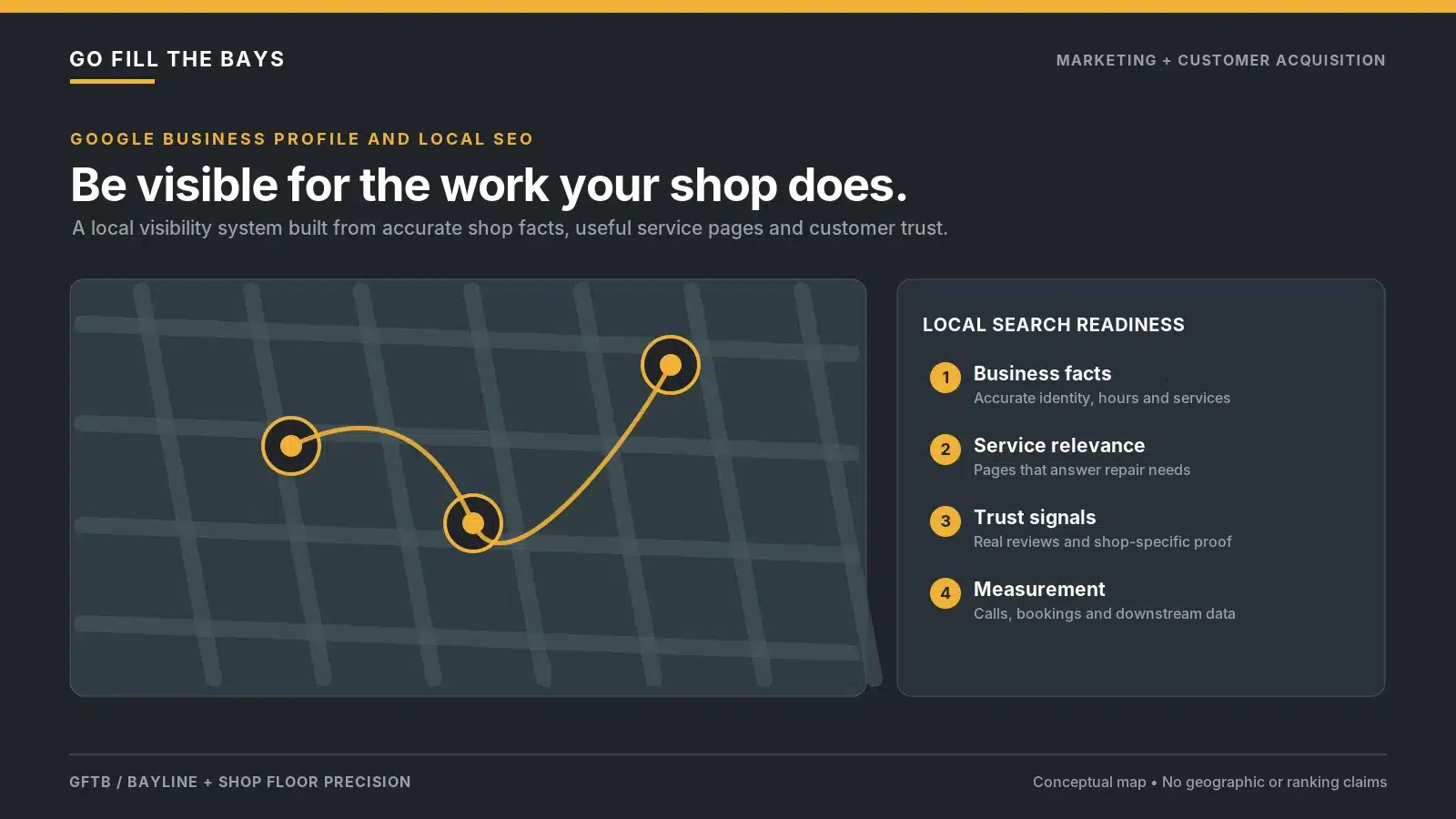
Conceptual local SEO system diagram; no ranking outcome is implied.
01
Thin service pages
Pages exist mainly to target phrases instead of helping a real customer decide.
02
Duplicate city or vehicle pages
Mass-produced variants create weak, overlapping content and muddy intent.
03
Irrelevant traffic
Visibility grows for informational or low-value queries disconnected from shop goals.
04
Technical/indexation issues
Important pages are not crawled, indexed, canonicalized, or internally linked correctly.
05
Weak architecture
Services, vehicles, locations, proof, and resources do not form a coherent site structure.
06
Commodity content
Generic copy does not demonstrate real repair expertise, operating context, or local usefulness.
WHAT GFTB DOES
Build search architecture around real customer intent and shop economics.
GFTB combines technical SEO, page architecture, content strategy, internal linking, structured information, and measurement with repair-specific demand priorities.
Technical SEO
Indexation, crawlability, canonicals, redirects, status codes, sitemaps, performance, and technical QA.
On-page SEO
Titles, headings, copy, entities, services, internal links, and page purpose.
Service + vehicle architecture
Create dedicated URLs only when the intent and content justify them.
Local relevance
Support real locations and markets without thin city-page manufacturing.
Internal linking
Connect services, guides, proof, audiences, and conversion paths contextually.
Structured data
Use accurate schema where useful and aligned with visible content.
Content gaps
Build useful owner/customer answers with original evidence, examples, process, and repair context.
Search Console analysis
Use query/page data to identify useful demand, cannibalization, decay, and opportunity.
REPAIR-SHOP CONTEXT
The SEO target is qualified demand—not the largest possible keyword footprint.
SERVICE PRIORITY
Job mix
Prioritize service demand the shop actually wants.
OPERATING CONTEXT
Capacity
Do not chase more car count when the real need is different work.
QUALITY
Commercial intent
Distinguish buying/service intent from traffic that is unlikely to become shop activity.
AUTHORITY
Content + social
Use real repair knowledge as authority support; do not create a separate thin content silo.
MEASUREMENT
Rankings are diagnostic. Qualified organic demand is the business question.
QUALITY
Qualified organic traffic
Traffic to commercially relevant pages from useful search intent.
SEARCH
Commercial query growth
Visibility for services and needs the shop actually wants to win.
CONVERT
Calls + bookings
Organic visitors who take a meaningful next action.
PAGE
Landing-page performance
Which pages attract, inform, and move the right visitors forward?
DISCOVERY
Non-branded service visibility
Track useful discovery beyond people already searching the shop name.
OWNER QUESTIONS
Questions worth answering before you spend more.
Why is traffic up but car count flat?
The traffic may be low-intent, poorly matched, or landing on pages that do not convert.
Do we need a page for every city and vehicle?
Only when the intent, facts, usefulness, and content justify a distinct page.
Does SEO include AI search?
Strong SEO is a foundation for GEO/AI-search readiness, but AI visibility also needs entity clarity, source readiness, and observed measurement.
Can you guarantee #1 rankings?
No. GFTB improves durable search fundamentals and commercially relevant visibility without guaranteed positions.
NEXT STEP
Find the search, content, architecture, and conversion gaps between rankings and real repair demand.
Audit the pages, queries, technical health, internal links, content quality, service priorities, and measurement path before producing more SEO content.