OTG SHOP PERFORMANCE / FIXED OPERATIONS CONSULTING
Get more out of the bays and hours you already have.
OTG fixed operations consulting helps you work through scheduling, job mix, workflow and capacity problems inside the shop. It is scoped separately from marketing.
GO FILL THE BAYS by OTG · Separate consulting/advisory lane
THE OPERATING PROBLEM
Sometimes the shop does not need more demand. It needs better use of the demand, capacity, people, and workflow it already has.
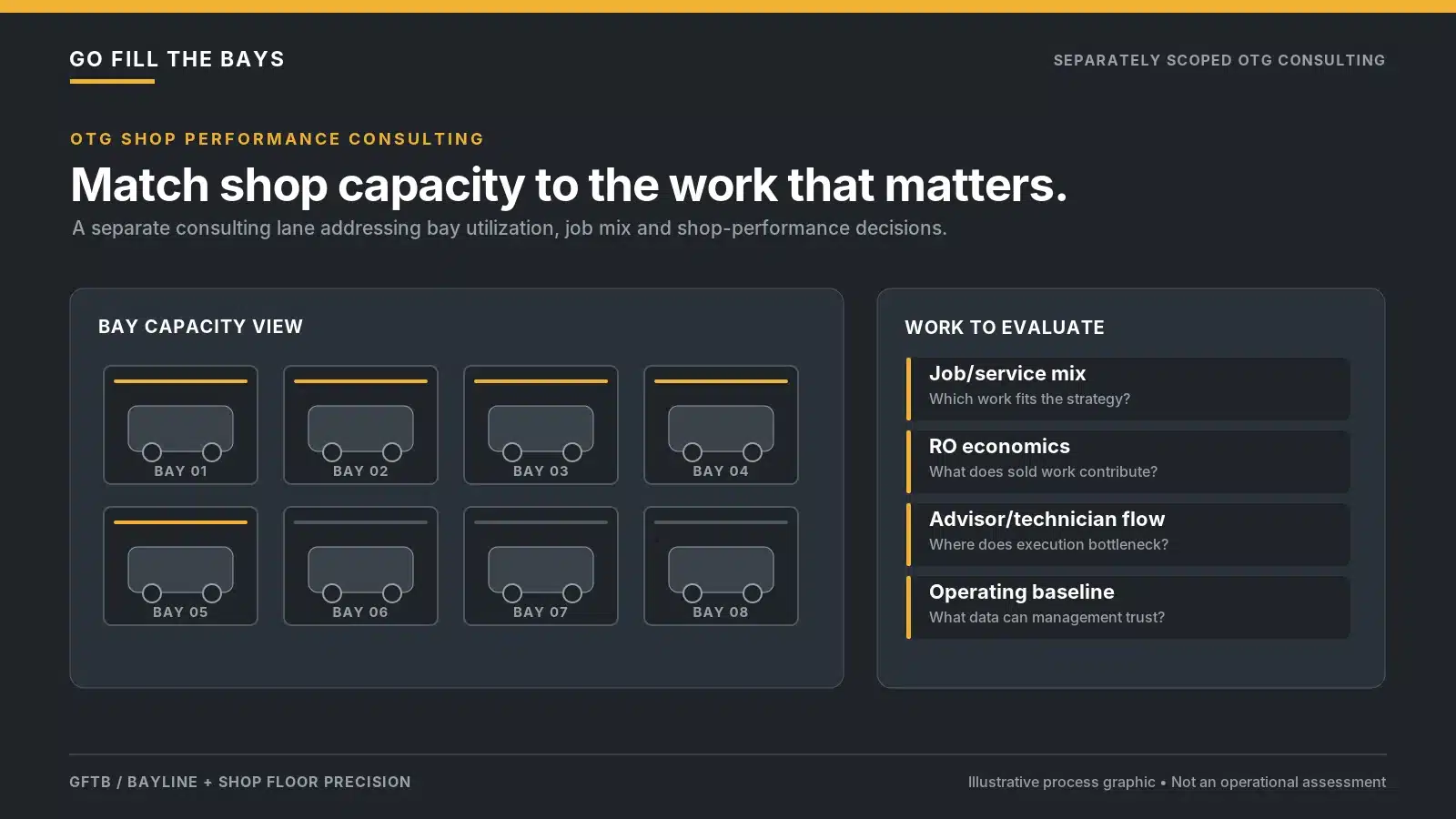
Illustrative shop-performance framework. This is a separately scoped OTG consulting service.
01
Capacity + bay utilization
Demand exists, but bay load, staffing, scheduling, or throughput prevents useful work from moving cleanly.
02
Job / service mix
Car count may look healthy while the mix of work does not support management's objectives.
03
RO economics
ARO/AWRO, RO values, sold work, and job categories need clearer definitions and management context.
04
Advisor process
Sales/process performance, presentation, follow-up, or close behavior may be inconsistent or poorly measured.
05
Technician performance
Productivity, efficiency, sold hours, workload, or skill deployment may be creating hidden constraints.
06
Workflow + dispatch
Scheduling, dispatch, shop load, handoffs, and work-in-process can create friction that marketing cannot fix.
APPROVED CONSULTING SCOPE
OTG can work directly on the operating-performance questions management needs answered.
Capacity + shop load
Car count, available capacity, bay utilization, appointment lead time, and shop-load analysis.
Job / service mix
What work is being sold, what work is underrepresented, and how the mix aligns with management objectives.
ARO / AWRO + RO economics
Define and review repair-order economics using the actual reporting method in use.
Advisor performance
Sales/process/performance review and coaching within the authorized consulting scope.
Technician performance
Productivity, efficiency, sold hours, workload, and related measures where reliable data exists.
Workflow / dispatch / scheduling
Review workflow, dispatch, scheduling, shop load, and throughput constraints.
KPI + management reporting
Define operating KPIs, scorecards, management cadence, and useful decision views.
Multi-location performance
Compare location-level performance without allowing group totals to hide shop-level variance.
Marketing-to-operations alignment
When both lanes are in scope, connect demand strategy to real capacity, job mix, scheduling, and constraints without confusing attribution with operational improvement.
HOW ENGAGEMENTS CAN WORK
Separately scoped consulting/advisory — not outsourced day-to-day shop management.
MODEL 01
Paid operating baseline
A defined initial diagnostic/baseline project using agreed operating questions, data, definitions, and date ranges.
MODEL 02
Defined project
A specific Fixed Operations project around an approved operating problem or management objective.
MODEL 03
30 / 60 / 90-day support
Optional structured implementation support after the baseline or project.
MODEL 04
Recurring coaching / management cadence
Optional ongoing advisory and accountability when the scope calls for continuing review.
Client management retains operating authority and accountability for implementation decisions unless a future separately approved scope explicitly states otherwise.
WHAT THE WORK REQUIRES
Useful fixed-operations consulting depends on reliable operating context and management participation.
Defined objective
Start with the operating problem leadership actually needs to solve.
Reliable reports + definitions
Use agreed shop-management reports, date ranges, KPI definitions, and known data gaps.
Authorized operating data
Scheduling, staffing, advisor, technician, RO, sold-hours, job-category, and location data only when relevant and authorized.
Process context
Enough context to distinguish data defects, one-time events, and real performance conditions.
Management participation
Leadership remains responsible for decisions, communication, implementation, and day-to-day execution.
Privacy + role controls
Employee-level information must be necessary to the defined purpose and handled with appropriate access controls.
TYPICAL DELIVERABLES
Turn the diagnosis into definitions, management visibility, and a prioritized action plan.
01
Operating baseline + KPI dictionary
Lock definitions and baseline period before interpreting change.
02
Capacity + shop-load analysis
Review car count, appointment lead time, bay/load conditions, and bottlenecks.
03
Job/service-mix review
Analyze the distribution of work against operating and demand priorities.
04
RO economics review
Define and assess ARO/AWRO, RO counts/values, sold work, and related economic measures.
05
Advisor / technician analysis
Review agreed process and performance measures without implying guaranteed outcomes.
06
Workflow / dispatch / scheduling findings
Document operating friction and its management implications.
07
Management scorecard
Create a usable operating view with agreed definitions, cadence, and known limitations.
08
30 / 60 / 90-day action plan
Prioritize management actions, owners, dependencies, and review cadence.
09
Multi-location variance review
Compare shops consistently when the engagement includes multiple locations.
MEASUREMENT
Use the shop-management system and authorized operating systems as the primary evidence.
Capacity / load
Car count, available capacity, appointment lead time, bay/shop load, and agreed utilization measures.
Job / service mix
Distribution of sold work under agreed categories and definitions.
ARO / AWRO + RO values
Use the exact shop reporting definition and state the reporting basis.
Advisor measures
Use agreed process/close/performance measures where definitions and data are reliable.
Technician measures
Productivity, efficiency, sold hours, and related measures under the shop's agreed definitions.
Workflow / throughput
Use defined measures and comparable periods while disclosing material operating changes.
Operating-performance measurement stays separate from marketing attribution. Better ARO/AWRO, productivity, sold hours, workflow, or capacity is not automatically caused by marketing, and more marketing demand is not proof of operational improvement.
NEXT STEP
If the constraint is operational, start with a direct conversation about the operating problem.
This is a separately scoped OTG consulting lane. The right starting point is a Strategy Call—not expanding the Fill The Bays Audit beyond its marketing/customer-acquisition purpose.