WHO WE HELP · MULTI-LOCATION REPAIR GROUPS
See what’s working at each of your repair shops.
Set the plan as a group. Track calls, appointments and repair orders by location so you know where to act.
GO FILL THE BAYS by OTG
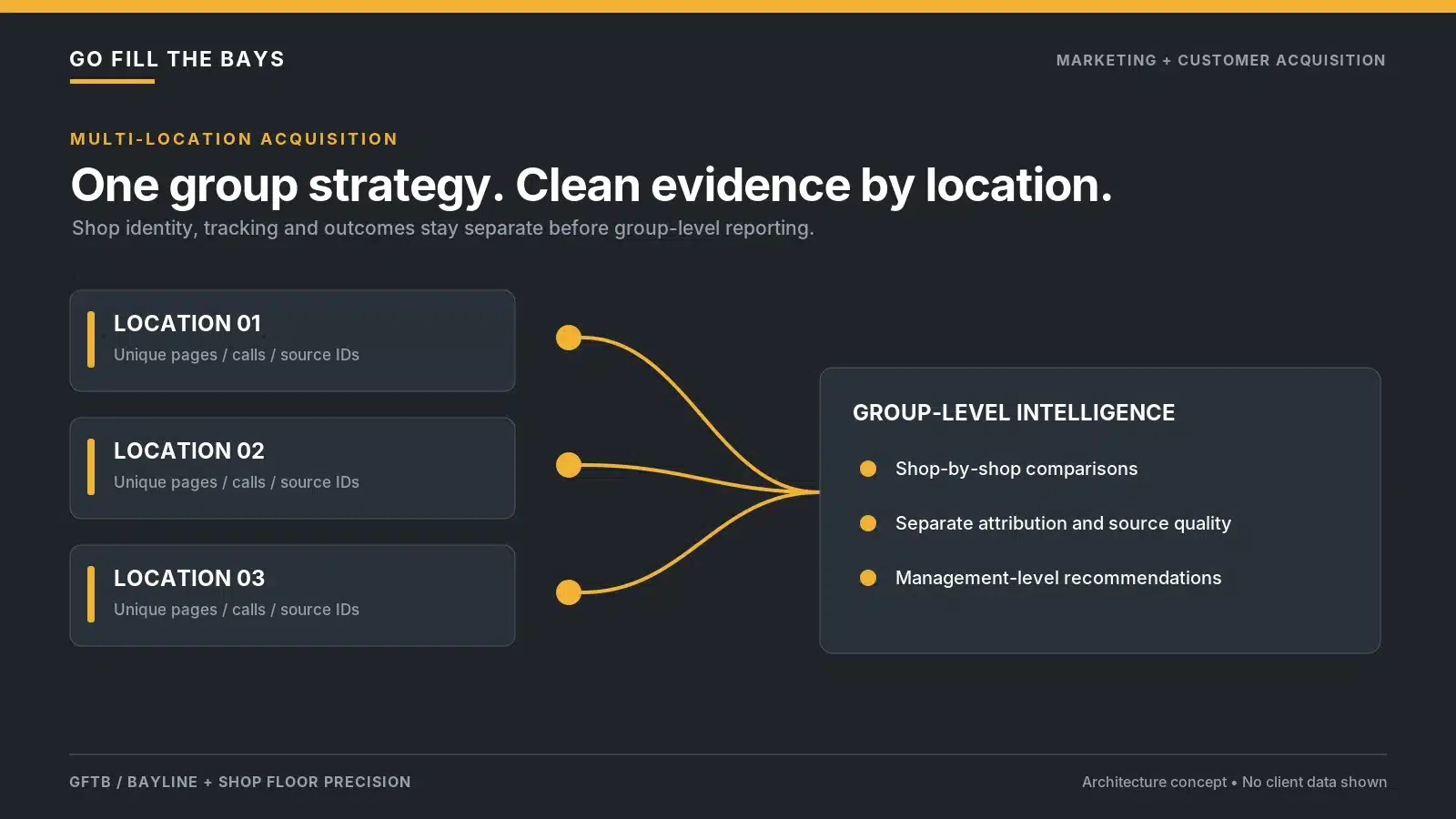
Illustrative per-location measurement architecture; no client data is displayed.
WHERE GROUP MARKETING BREAKS
Group-level consistency should not erase what is true at each shop.
01
Cross-location contamination
Wrong addresses, phones, staff, reviews, offers, photos, CTAs, booking links, or local references get mixed between shops.
02
Duplicate strategy
Every location receives the same campaigns, pages, content, and budget even when demand and operating conditions differ.
03
Blended reporting
A strong location hides a weak one because management sees only a group average.
04
Uneven account structure
Some locations have clean GBP, ads, tracking, landing pages, and access while others do not.
05
Budget by habit
Spend is divided evenly instead of following opportunity, capacity, economics, and performance.
06
Source identity gets lost
Calls, bookings, CRM records, and shop outcomes cannot be reliably tied back to the correct location.
HOW GFTB APPLIES THE SYSTEM
Shared strategy where it scales. Local execution where facts and outcomes differ.
Google Ads + LSA
Use shared governance with location-specific campaigns, geography, service priorities, budgets, calls, and landing paths.
Explore Google AdsGBP + Maps
Treat each physical location as its own entity with accurate categories, services, hours, photos, reviews, and local relevance.
Explore GBP + MapsSEO + Websites
Create location/service architecture that reflects real local intent without mass-producing thin duplicate pages.
Explore SEOGEO + AI Search
Keep entity facts, services, locations, and sources clear and consistent across public surfaces used in AI-assisted discovery.
Explore GEO + AI SearchTracking + Attribution
Preserve location identity through calls, booking, CRM, and shop outcomes before rolling performance up to the group.
Explore AttributionStrategy + Vendor Oversight
Coordinate vendors, internal teams, ownership, budget direction, QA, and management reporting across the group.
Explore StrategyMULTI-LOCATION AUDIT STANDARD
Begin with group goals — then inspect every location separately.
01
Group-level objective
Define what the group is trying to change before comparing shops.
02
Inspect each location
Check NAP, GBP, landing pages, calls, booking links, offers, reviews, content, tracking, and performance by shop.
03
Do not average away weakness
A group average should not hide a low-performing location or broken measurement path.
04
Flag contamination explicitly
Cross-location identity or routing defects are their own audit category.
05
Show both levels
Present location findings first, then a group roll-up that preserves context.
06
Preserve location through outcomes
If internal data is supplied, keep location identity through appointment and RO matching.
MEASUREMENT
See which shop is winning, leaking, or simply measured differently.
01
Qualified demand by location
Separate useful and poor-fit lead demand for each shop.
02
Appointments / ROs by location
Follow outcomes downstream without blending locations or forcing attribution.
03
Budget efficiency
Judge spend against local opportunity, capacity, economics, and evidence.
04
Data integrity
Track source continuity, duplicate records, wrong-location routing, and contamination as QA findings.
05
Group roll-up
Aggregate after shop-level QA so totals remain decision-useful.
WHEN OPERATIONS DIFFER BY LOCATION
Marketing variance and operating variance are not the same thing.
One shop may need more demand while another is capacity-constrained. One may have a marketing leak while another has an operating-performance constraint. OTG can separately scope multi-location Fixed Operations consulting when management needs help with capacity, job mix, RO economics, advisor/technician performance, workflow, scheduling, KPIs, or location variance.
Marketing lane
Use GFTB to manage local discovery, trust, conversion, scheduling, sold-work measurement, attribution, and group marketing governance.
Fixed Operations lane
Use a separate OTG consulting scope when the constraint is inside one or more shops. Client management retains operating authority.
Explore Fixed OperationsGROUP LEADERSHIP QUESTIONS
Questions multi-shop operators should be able to answer.
Which location is producing the best qualified demand?
Compare shop-level lead quality and downstream outcomes before relying on group totals.
Should every shop get the same budget?
No. Budget should follow opportunity, capacity, economics, and performance rather than an automatic equal split.
Can we centralize everything?
Centralize standards and governance where useful; keep local facts, identity, routing, proof, and performance location-correct.
How do we stop cross-location contamination?
Use location-specific QA for NAP, GBP, pages, calls, booking, reviews, offers, content, tracking, and reporting.
NEXT STEP
See the group clearly without losing the individual shops inside it.
Run the Fill The Bays Audit with multi-location scope so group goals are defined first, every location is inspected separately, contamination is surfaced, and the final view shows both shop-level findings and the group roll-up.