HOW WE FILL THE BAYS
See how a call turns into work in your bays.
We find where drivers drop off between searching, calling, booking and approving a repair. Then we show you what to fix first.
THE BAY FLOW
Six stages. One connected acquisition route.
The stage names stay consistent because the operating questions stay consistent. What changes is how much evidence each shop can actually support.
01
SEARCH
Search, Maps, Google Ads, LSA, organic visibility, and relevant AI-assisted discovery.
02
TRUST
Reviews, photos, proof, accurate business facts, service clarity, and website credibility.
03
CONVERT
Calls, forms, booking paths, landing pages, message match, and mobile friction.
04
SCHEDULE
Lead quality, call handling, booking flow, appointment status, and source integrity.
05
SELL
Arrival, repair orders, job mix, authorized work, and sold work where evidence exists.
06
MEASURE
Analytics, call tracking, CRM data, shop-management matching, and known attribution gaps.
Rule: stop at the last defensible stage when the evidence runs out.
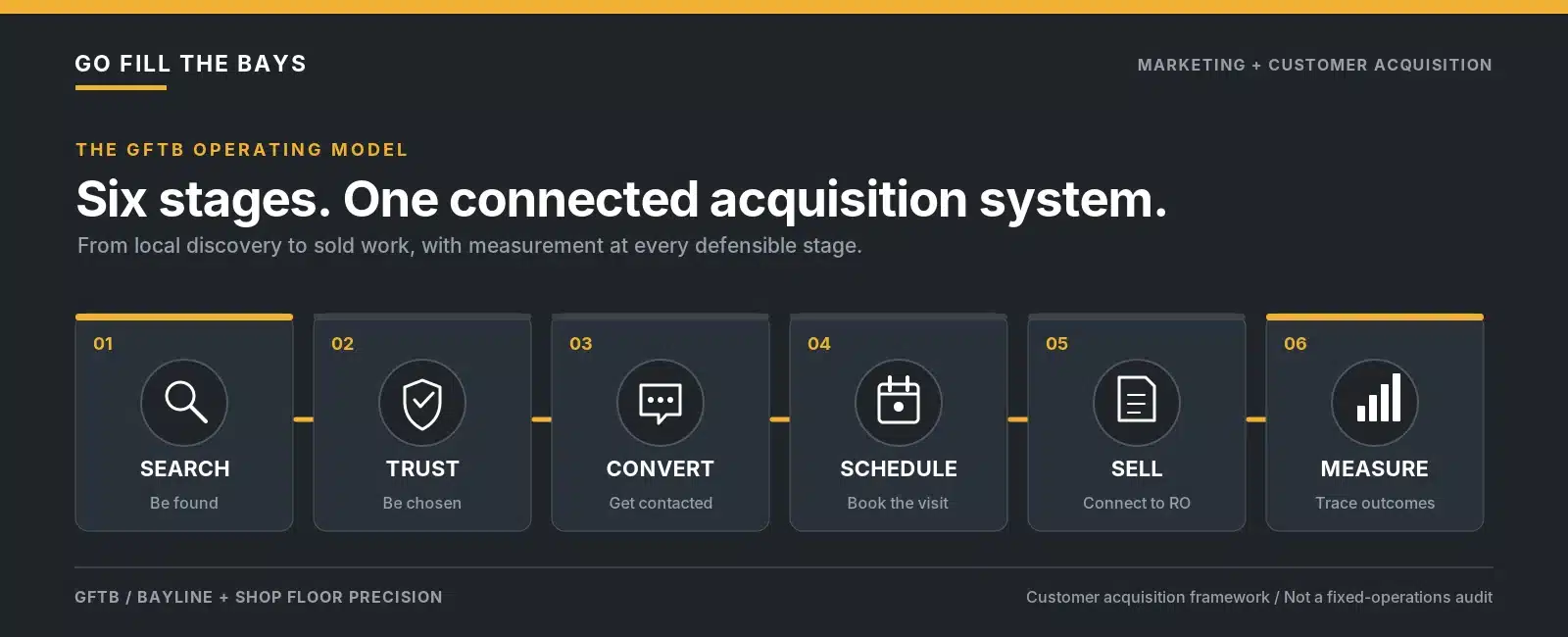
GFTB's six-stage marketing and customer-acquisition framework; not a general fixed-operations audit.
WHERE THE HANDOFFS BREAK
The leak is often between tools, teams, and definitions—not inside one marketing channel.
SEARCH + TRUST
Upstream
Search terms, profiles, ads, pages, reviews, and content create visibility and trust. They still need to attract the right repair demand.
CONVERT + SCHEDULE
Handoff
Calls, forms, booking, and advisor handling determine whether useful demand becomes a real appointment.
SELL + MEASURE
Downstream
RO and sold-work data show what actually reached the shop floor—when source continuity is good enough to reconcile it.
THE AUDIT USES THE SAME SIX MODULES
Diagnose the leak before choosing the service.
The Fill The Bays Audit gets deeper only when reliable evidence is available. Missing private data is marked Not Assessed—not scored as failure.
DEPTH A
Public Front-Door Scan
Public website, location, listings, visible Search/Trust/Convert signals, and measurement readiness.
DEPTH B
Acquisition Funnel Review
Adds authorized ads, GBP, analytics, call, or CRM evidence to review lead quality, booking, and attribution breaks.
DEPTH C
Full Downstream Baseline
Adds authorized appointment, RO, and sold-work evidence to evaluate Schedule/Sell/Measure and source-to-RO continuity.
NEXT STEP
Find the stage where qualified demand is leaking.
Start with the Audit. The recommendation should follow the diagnosis—not the other way around.