GEO + AI SEARCH VISIBILITY
Help people find your repair shop through AI search.
Give search engines and AI tools clear facts about your services, locations and expertise so they can describe your shop accurately.
GO FILL THE BAYS by OTG
WHERE AI DISCOVERY BREAKS
AI visibility problems usually start with unclear facts, weak source material, or technical friction.
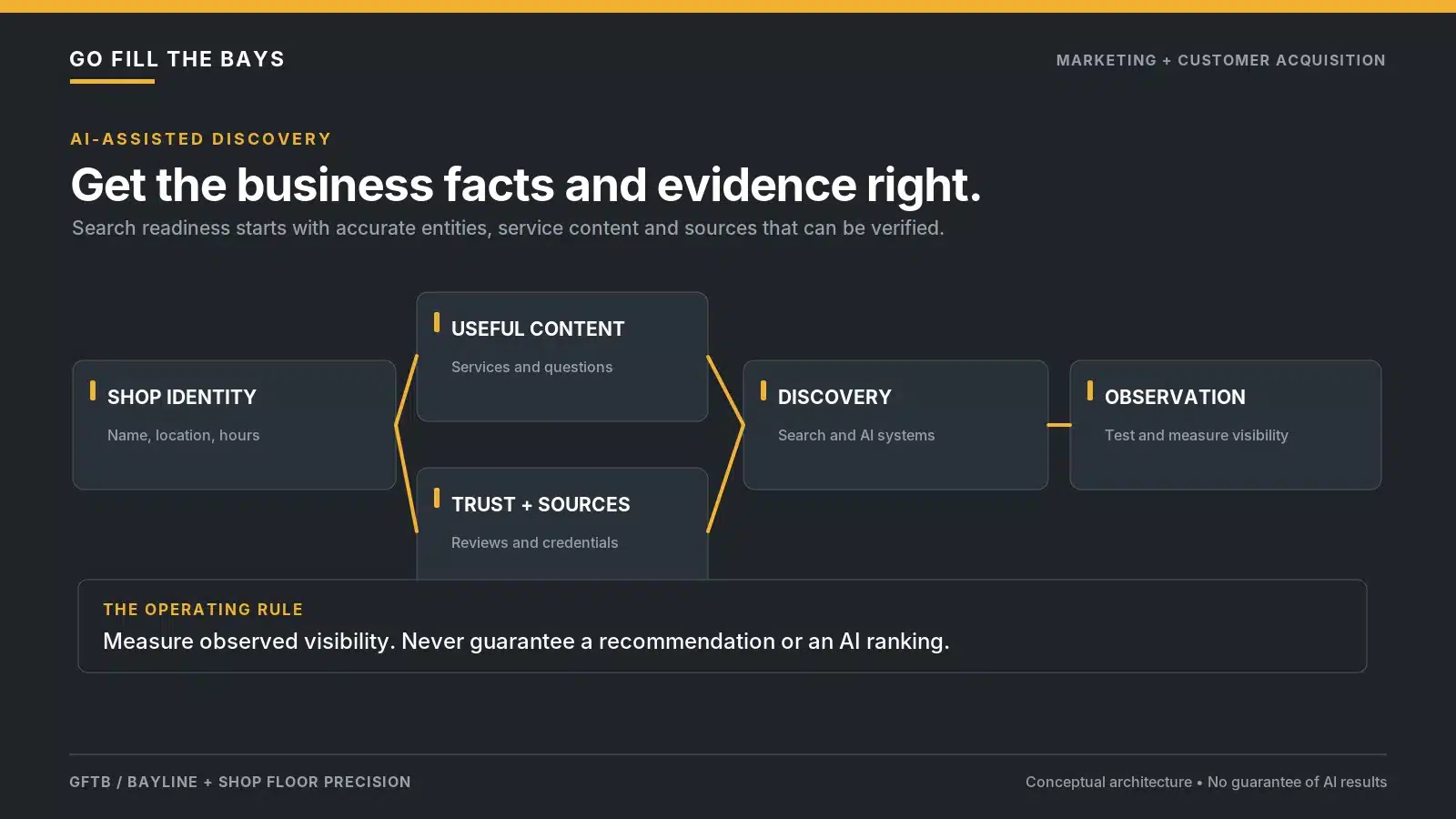
Conceptual AI-assisted discovery architecture; no ranking or recommendation is guaranteed.
01
Unclear entity
The site does not make the shop, locations, services, expertise, and relationships easy to understand.
02
Crawler or index friction
Important pages, text, media, or paths are hard to discover, retrieve, or process.
03
Commodity content
Pages repeat generic repair or marketing language without original evidence, expertise, or useful specificity.
04
Inconsistent facts
Website, GBP, citations, and location pages disagree about business facts, services, or identity.
05
Weak source readiness
Claims are vague, unsupported, or buried instead of being stated clearly with methodology and evidence.
06
No observation loop
Nobody is tracking referral data, citations, controlled test queries, or factual retrieval quality over time.
WHAT GFTB DOES
Build GEO as a disciplined extension of SEO, local identity, content, and measurement.
01
Entity + fact model
Clarify the shop, locations, services, expertise, ownership/brand relationships, and core facts the public site should express.
02
Technical discovery review
Check indexability, crawl paths, robots controls, canonicals, real-text availability, internal links, and public accessibility.
03
Answerability + content architecture
Create useful pages that answer real owner/customer questions with shop-specific substance rather than query-variant filler.
04
Schema + structured information
05
Citation/source analysis
Inspect where important facts and claims come from, where source-worthy evidence is missing, and where third-party inconsistency creates ambiguity.
06
Visibility observation
Run controlled checks, monitor referral/citation signals where observable, document limitations, and turn findings into testable improvements.
MEASUREMENT
Measure AI-assisted discovery by observable evidence—not hype metrics.
01
Observed visibility
Where the shop or its pages surface in controlled, repeatable AI-assisted discovery checks.
02
Retrieval clarity
Whether systems return the right services, location facts, expertise, and distinctions.
03
Citation/source presence
Whether public sources or pages are referenced when that behavior is observable.
04
Fact consistency
Whether answers stay aligned with the real public business information.
05
Referral data
Track attributable AI/search referrals when the source can be observed.
06
Downstream outcomes
If referrals become qualified leads, appointments, ROs, or sold work, follow them only as far as the evidence supports.
OWNER QUESTIONS
What shop operators should ask about GEO and AI search.
Does GEO replace SEO?
No. GEO extends the same durable foundations: useful content, technical access, entities, local facts, trust, and evidence.
Do we need special AI schema?
Can you guarantee ChatGPT or Google AI will recommend us?
No. We can improve readiness, clarity, source quality, and observed visibility; platform recommendations are not guaranteed.
How do we know whether it is working?
Track observable referrals, citations, factual retrieval, controlled visibility checks, and downstream outcomes where source continuity exists.
NEXT STEP
Find the gaps that make your shop harder for search and AI systems to understand.
Start with AI/Search readiness as part of the larger acquisition system—then fix the facts, content, technical discovery, sources, and measurement that actually need work.