GOOGLE ADS FOR AUTO REPAIR
Google Ads for the repairs you want to book.
Tell us which jobs your shop wants. We build around those searches, cut unrelated traffic and check which calls turn into appointments.
GO FILL THE BAYS by OTG
WHERE IT BREAKS
Cheap calls are expensive when they are the wrong calls.
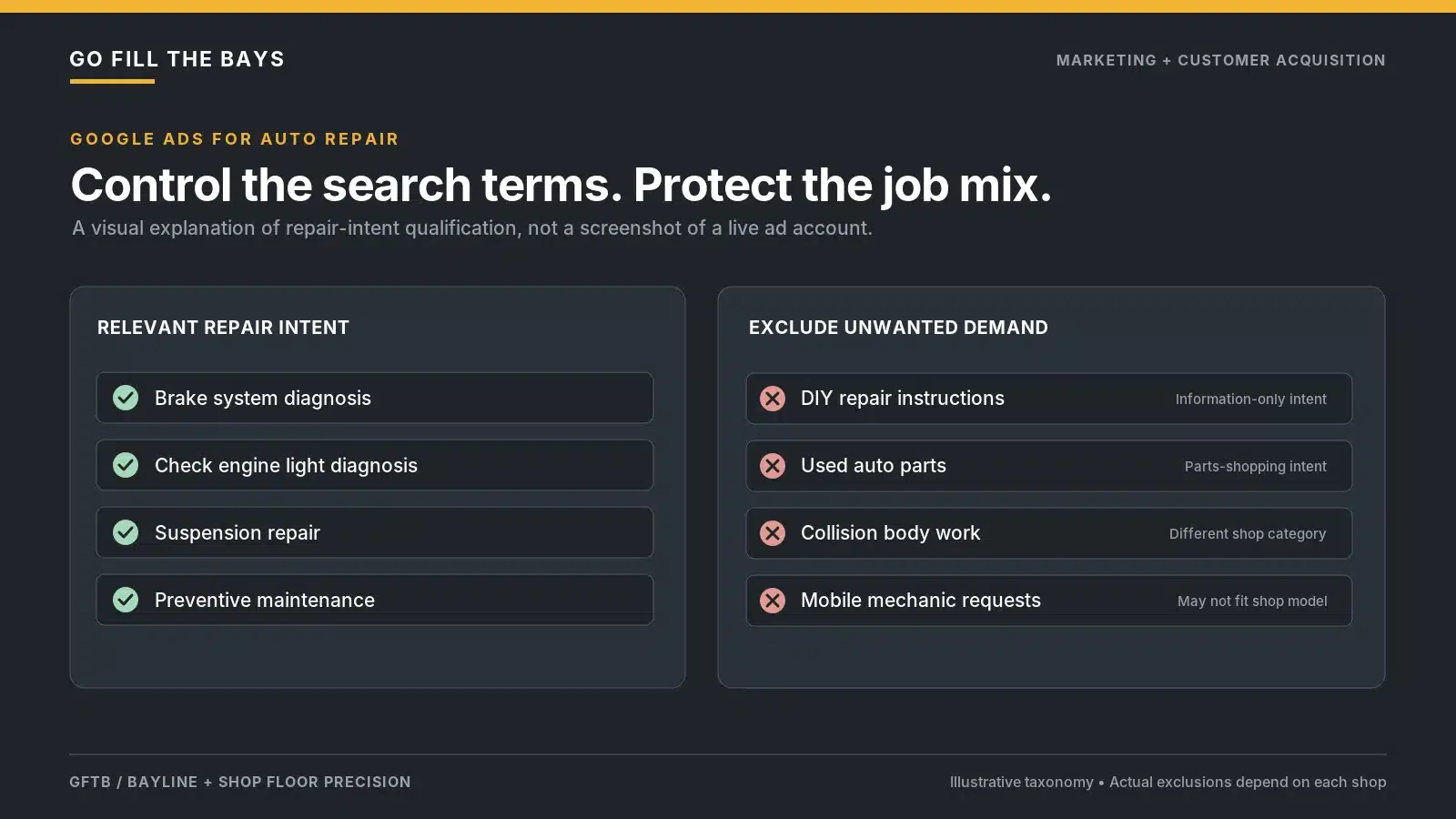
Illustrative example of search-intent quality, not actual client campaign data.
01
Irrelevant searches
Search terms drift into DIY, parts, body work, mobile-mechanic, price-only, or otherwise poor-fit demand.
02
Wrong service mix
Campaigns create demand for work the shop does not need more of while higher-priority services stay underrepresented.
03
Geographic waste
Spend leaks outside useful service areas or across locations without clean control.
04
Conversion inflation
Platform conversion counts make performance look stronger than the actual qualified-call or appointment picture.
05
Landing-page mismatch
The ad promise, service page, trust signals, and next action do not line up.
06
Black-box automation
Automation is allowed to make important choices without clear inputs, exclusions, definitions, or downstream feedback.
WHAT GFTB DOES
Control the inputs that determine which repair demand you buy.
GFTB treats Google Ads as a repair-demand system connected to landing pages, lead quality, appointment flow, and downstream measurement.
Campaign architecture
Structure around real services, markets, locations, intent, and management priorities.
Search terms + negatives
Review actual query behavior and actively exclude demand the shop does not want.
Job-mix alignment
Map campaigns and budgets to service priorities, economics, capacity, and seasonality.
Geographic + budget control
Allocate spend by real opportunity rather than even splits or platform defaults.
Landing-page alignment
Match the search, ad, page, proof, CTA, and booking/call path.
Conversion design
Define qualified calls, bookings, appointments, and offline outcomes correctly before optimizing around them.
Automation governance
Use automation where it helps while keeping objectives, exclusions, budgets, and outcome definitions under accountable review.
REPAIR-SHOP CONTEXT
The best campaign depends on what the shop can actually sell and fulfill.
OPERATING INPUT
Capacity
More demand is useful only when the shop has room for it—or when demand should shift toward a better service mix.
ECONOMICS
Service economics
Higher-value repair categories may justify different acquisition costs than commodity work.
QUALITY
Unwanted demand
Define what the shop does not want so exclusions are as deliberate as targeting.
LOCATION CONTROL
Multi-location
Each location needs clean budgets, landing pages, calls, geography, and outcome reporting.
MEASUREMENT
Count the closest reliable business outcome—not the easiest platform number.
DIAGNOSTIC
Search-term quality
What share of spend and clicks came from commercially relevant repair intent?
LEAD QUALITY
Qualified calls
How many calls actually fit service, vehicle, geography, timing, and shop criteria?
SCHEDULE
Appointments
Which qualified leads became usable scheduled visits?
RO
Matched ROs
Which tracked leads or appointments can be defensibly matched to opened repair orders?
REVENUE
Attributed revenue
Use only when source matching and shop-system values actually support it.
OWNER QUESTIONS
Questions worth answering before you spend more.
Why am I paying for calls that never become cars?
Because a platform can count activity without knowing whether the call fit, booked, arrived, or opened an RO.
Should I optimize for the cheapest lead?
Not automatically. Lead quality, service economics, appointment rate, and capacity matter.
Should my agency own the Google Ads account?
GFTB prefers client ownership or durable administrative access to core digital property where the platform permits.
How much automation should I use?
Enough to improve execution—not enough to surrender strategy, exclusions, definitions, or accountability.
NEXT STEP
Find out whether Google Ads is buying the repair demand your shop actually needs.
Audit search terms, service alignment, conversion definitions, lead quality, landing-page fit, account access, and downstream measurement before simply raising budget.